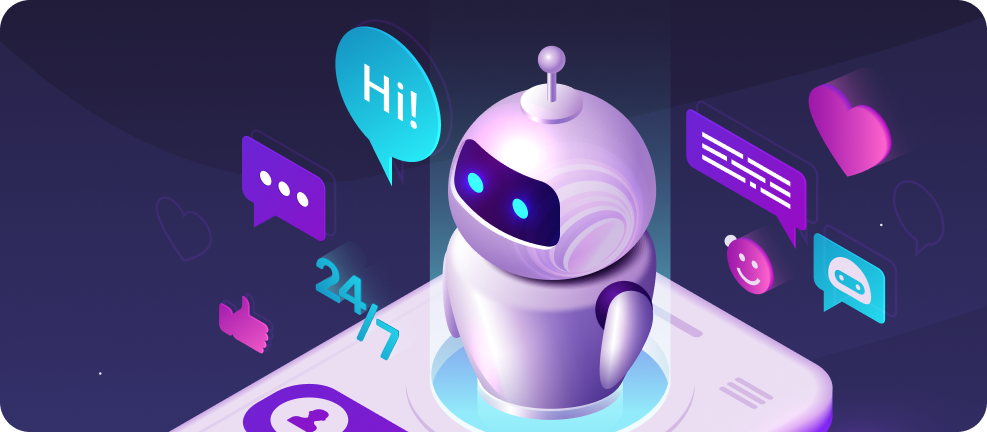
Advises the client on the most difficult issues that require verification in a third-party system (for example, reports the account balance, calculates the possibility of issuing a loan).
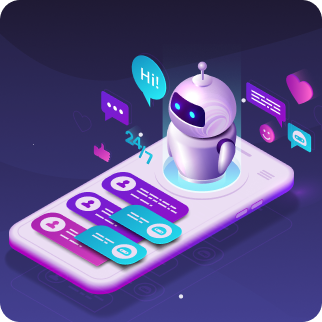
Our sophisticated bots are capable of solving tasks that require integration with external systems and databases.
Sophisticated bots can personalize responses, taking into account the data of each specific client.
Thanks to sophisticated algorithms and access to up-to-date information, bots provide accurate and timely answers to customer questions.
Such bots are able to process several requests at once and provide information in real time.
Developing an AI chatbot involves creating an intelligent system capable of complex contextual dialogue, rather than just responding to a given scenario. Unlike standard bots that operate on the principle of "stimulus-response" (for example, pressing a button → standard response), an intelligent chatbot uses machine learning and natural language processing (NLP/NLU) technologies.
The key differences of a complex AI bot:
Understanding context and intent: The bot analyzes not only individual keywords, but also the general meaning of the message, taking into account previous phrases in the dialogue. This allows him to maintain a coherent conversation, rather than just answering isolated questions.
Self-learning and adaptation: AI chatbots are constantly learning from new data and user interactions, improving the accuracy of their responses over time. They identify patterns and improve their algorithms without the constant intervention of developers.
Generating unique responses: Instead of pre-prepared phrases, complex bots can generate meaningful, variable responses, adapting to the communication style of a particular user.
Solving non-standard tasks: They are able to process requests that were not explicitly written in scripts using logical inference and analysis of available information.
Thus, the development of chatbots with artificial intelligence is not just the creation of an automation tool, but a virtual employee capable of meaningful communication.
A sophisticated chatbot is capable of solving a wide range of business tasks that go far beyond the capabilities of standard solutions. Its implementation is particularly effective in areas that require deep analytics and a personalized approach.
The main directions of application:
Multi-level technical support: The bot can diagnose a problem by asking clarifying questions and offering step-by-step instructions on how to solve it, which significantly offloads live operators.
Personal selection of goods and services: By analyzing user preferences and behavior (purchase history, pageviews), an AI bot can offer highly relevant recommendations, significantly increasing conversion.
Complex financial and legal advice: The bot is able to analyze documents (for example, uploaded by the user), interpret the terms of contracts and make personal recommendations based on complex algorithms.
Internal HR Assistant: Can conduct initial interviews, analyze resumes, answer difficult questions from employees about corporate policy, etc. .
Bottom line: By ordering the development of an intelligent chatbot, you get a tool for deep automation of key business processes, which not only saves resources, but also creates additional value for customers.
The process of developing a complex chatbot is an iterative cycle that requires close interaction between the customer and a team of specialists (data scientists, linguists, ML engineers).
Key stages of development:
In-depth domain analysis: Experts dive into the specifics of your business, study terminology, typical communication scenarios, and goals that a bot should achieve.
Data collection and markup: To train a model, you need a large amount of high—quality data - dialogues, documents, FAQ. This data is carefully marked up: intents (user intentions) and entities (key objects in the query) are determined.
Architecture design and model training: ML engineers select and configure suitable machine learning algorithms and neural networks. The model is trained on the marked-up data to learn how to understand queries.
Dialog logic development: Flexible logic is being created that allows the bot to conduct a non-linear dialogue, request missing information, and process multitasking scenarios.
Integration and testing: The bot integrates with the necessary systems (CRM, knowledge base, ERP). Testing takes place in several stages, including A/B testing of different versions of the model to select the most effective one.
Launch and continuous retraining: After launch, the bot continues to learn from real dialogues. The monitoring system monitors its operation, and specialists regularly retrain the model based on new data.
The development of AI chatbots is based on the use of modern and powerful technologies from the field of machine learning and data processing.
The main technology stack includes:
Frameworks for machine learning: Python with TensorFlow, PyTorch, and Keras libraries for creating and training complex neural network models capable of understanding context.
Natural Language Processing (NLP/NLU) Platforms: Using tools such as Rasa, Google Dialogflow CX, Amazon Lex or Microsoft Bot Framework, which provide powerful tools for intent recognition and entity extraction.
Generative models: Advanced language models like GPT (Generative Pre-trained Transformer) can be used to create unique answers, rather than just selecting from a database.
Tools for data collection and analysis: Using Big Data platforms to process large volumes of dialogues, which is the basis for high-quality model training.
The choice of specific technologies depends on the tasks of the bot, the required level of customization and the project budget.
Evaluating the effectiveness of a complex chatbot requires analyzing both quantitative and qualitative metrics that go beyond simple metrics like the number of processed conversations.
Key metrics for evaluation:
Request Resolution Ratio (First Contact Resolution): What percentage of problems does the bot solve on its own, without passing it on to the operator. For a complex bot, this indicator should be high.
User Satisfaction Level (CSAT): A direct assessment of the quality of help from users after the end of the dialogue.
Reducing the burden on operators: It is measured in reducing the number of calls to the contact center and saving man-hours.
Impact on business performance: Increased conversion in sales (if the bot is engaged in consulting), an increase in the average receipt, a reduction in the number of refunds due to more accurate recommendations.
Cost per processed request: Gradual reduction of this cost due to scaling and automation.
The ROI (return on investment) is calculated by comparing savings on operating costs (operator salaries) and revenue growth with the cost of developing and implementing a bot.